Image Generation API Pricing: Calculate Cost per Usable Image
Compare image APIs against the same delivery requirements, not just a headline generation price. Separate API spend from review and rework, reconcile requests with accepted assets, and use a clearly hypothetical example to find when a cheaper API stops being the cheaper workflow.
·
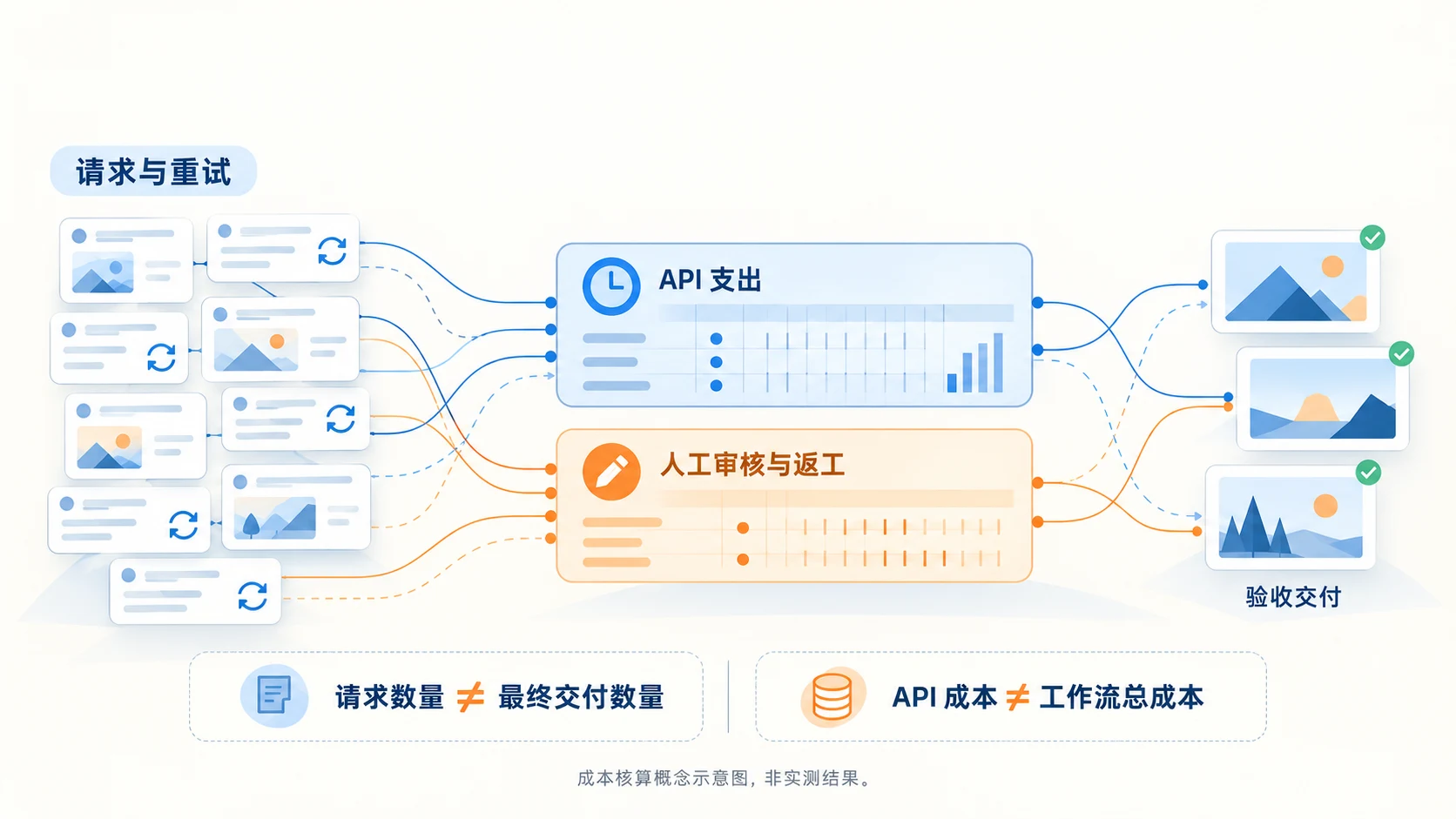
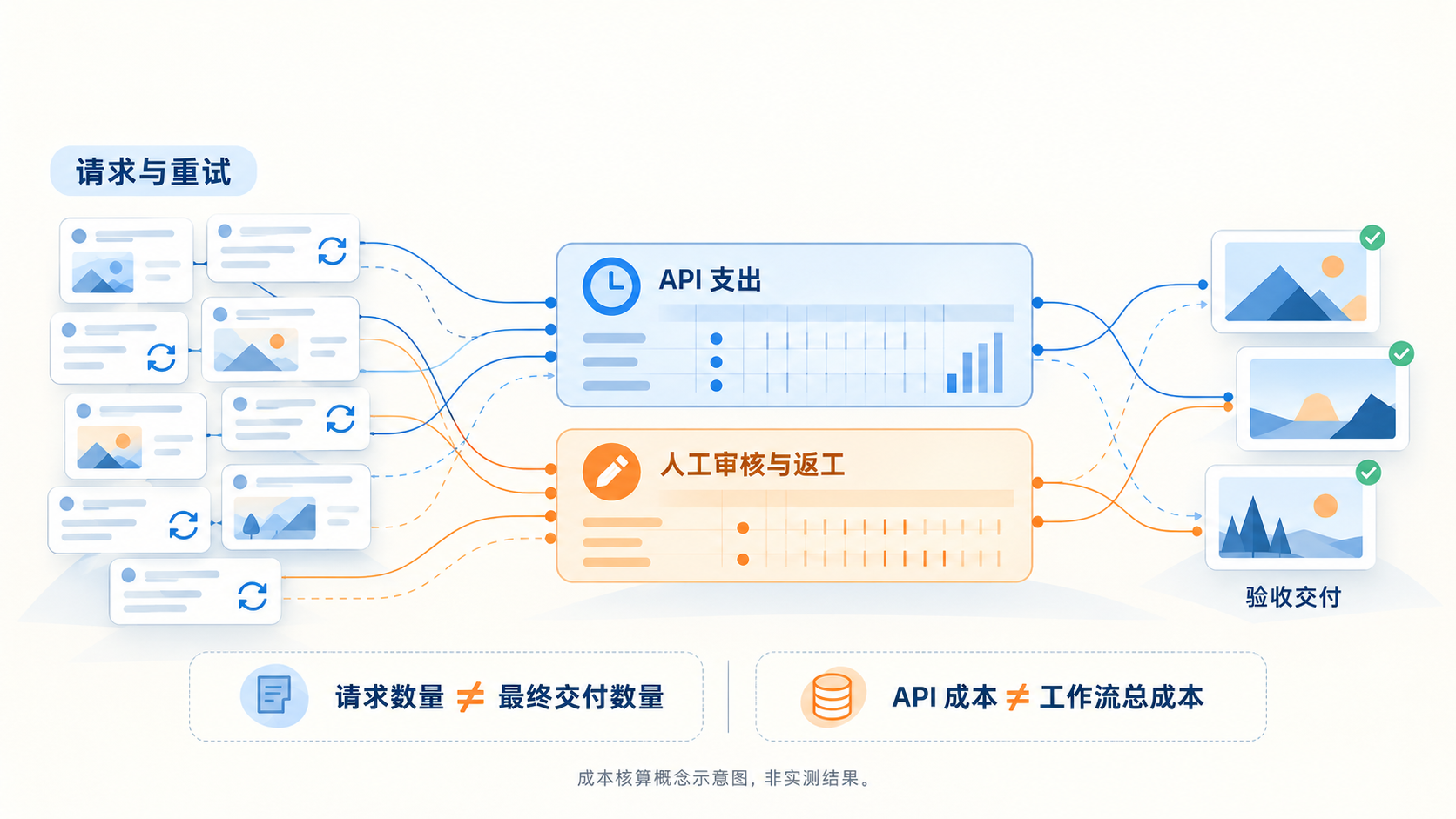
The useful question behind image generation API pricing is: how much does it cost to deliver one accepted image under the same requirements? A low request price does not establish a low delivery cost, and an assumed acceptance rate does not establish a real provider winner.
This is a costing method, not a current price ranking. The available third-party reference says its prices were checked on July 21, 2026. Current first-party prices, failure-billing terms, and InkRoom's live catalog have not been verified here. Current quotation comparisons and purchasing conclusions therefore remain unresolved.
Define the deliverable before counting it
Write a short acceptance specification: dimensions, file format, required subject details, text accuracy requirements, permitted manual correction, and delivery deadline. Keep that specification consistent across routes.
Distinguish three units:
- Request: one generation, edit, or other operation.
- Output: an image returned by a request; one request may return several.
- Delivered asset: the final image accepted for use.
An initial image followed by two revisions is not three delivered assets. Nor is a request count automatically an output count. Assign each final asset an identifier and link its requests to it.
The reference article identifies resolution, workflow, and approval rate as comparison factors. The additional accounting step here is to separate delivered assets from calls, so the spending numerator can be reconciled with the delivery denominator.
Normalize the quote, not the marketing label
Fix each route's model and version, output dimensions, quality setting, outputs per request, and image-input conditions. Different providers need not use identical setting names, but their outputs must satisfy the same acceptance specification. Matching labels such as “high quality” do not prove equivalence.
This table is an accounting framework, not a description of any provider's current terms.
| Billing basis | Evidence to capture | Do not assume |
|---|---|---|
| Per image | Billable image definition, count, size and quality conditions | Rejected outputs are refunded |
| Tokens | Separate input and output usage categories and rates | Text length alone predicts the full image request cost |
| Pixels or resolution | Actual dimensions, billing increments and minimum units | A starting price applies at every size |
| Subscription or credits | Period fee, credit conversion, expiry and overage terms | Unused allowance is costless, or one credit means one image |
For each quote, retain the source URL, verification date, currency, tax treatment, and account conditions. Check failed, timed-out, cancelled, refused, and retried requests separately. Unknown is neither free nor automatically billable at the successful-request rate. Leave unresolved items pending rather than entering zero.
Keep API spend and workflow spend separate
Use a request ledger with request ID, asset ID, model version, settings, operation, image inputs, status, available metered usage, confirmed charge, output count, and acceptance status. Mark unavailable charges as unresolved.
Keep a second ledger for review and correction time, plus any storage, conversion, and delivery costs included in your budget. If no labor rate is available, report minutes rather than inventing a monetary value.
API cost per usable image = Confirmed API spend ÷ Accepted final assets
Workflow cost per usable image = (API spend + Labor cost + Other included costs) ÷ Accepted final assets
If retries already appear in billed request totals, do not add a second retry surcharge. Retain failed requests in the record, include confirmed charges in actual spend, and list unresolved charges separately. With no accepted assets, the metric is undefined—not zero.
For subscriptions, show actual period payments separately from the estimated value of consumed credits. Adding both can double-count costs; reporting only consumed credits can hide paid-for idle capacity.
A hypothetical example and its break-even point
All figures below are invented accounting units for arithmetic only. They are not currency quotes, benchmarks, or provider results. Both routes hypothetically deliver 20 accepted assets against the same specification. API spend includes all charged inputs, retries, and edits in the exercise.
| Item | Hypothetical route A | Hypothetical route B |
|---|---|---|
| Confirmed API spend | 12 units | 18 units |
| Review and correction time | 60 minutes | 20 minutes |
| Assumed labor rate | 0.2 units/minute | 0.2 units/minute |
| API cost per usable image | 0.60 units | 0.90 units |
| Workflow cost per usable image | 1.20 units | 1.10 units |
Other costs are excluded. A has lower API spend, while B has lower workflow cost at the assumed labor rate.
The condition that changes the result is also calculable: B costs 6 more API units and saves 40 labor minutes. The break-even labor rate is 6 ÷ 40 = 0.15 units per minute. Above that rate, B is cheaper in this example; below it, A is cheaper. This sensitivity analysis is more useful than declaring a universally cheapest model without the team's cost assumptions.
Validate the budget with a bounded pilot
Sample tasks from your actual work queue, retaining its mix of easier and harder jobs. Lock acceptance criteria before testing. Record all calls, not just successful examples, and include repeat runs in spend. Report accepted counts with their denominators rather than presenting a percentage alone.
Set a spending cap and stopping conditions before the pilot. Inspect cost, correction time, and delivery deadlines by task category so an overall average does not hide repeated failures in one category.
If your next step genuinely requires programmatic calls or system integration, see InkRoom's image API introduction and access entry. This is an entry-point recommendation, not a claim about fixed prices, concurrency, or output quality. Record spend, retries, and accepted assets yourself; a manual production task does not need an API merely to measure its costs.
When current rates, failure charges, or credit rules remain unresolved, continue collecting evidence—but withhold a definitive purchasing budget or provider ranking.
Related articles and cases
- Image editing API: reference-image integration and product checks
Define acceptance criteria before connecting an image editing API. Plan reference inputs, response handling, downloads, and failures without inventing an unverified InkRoom request.