AI Image Watermarking: What Visible Marks, Invisible Watermarks, and C2PA Tell You
A visible label, a scheme-specific watermark, and signed provenance answer different questions. Learn how to preserve originals, record exports, and verify samples without treating “not detected” as proof of human authorship.
·
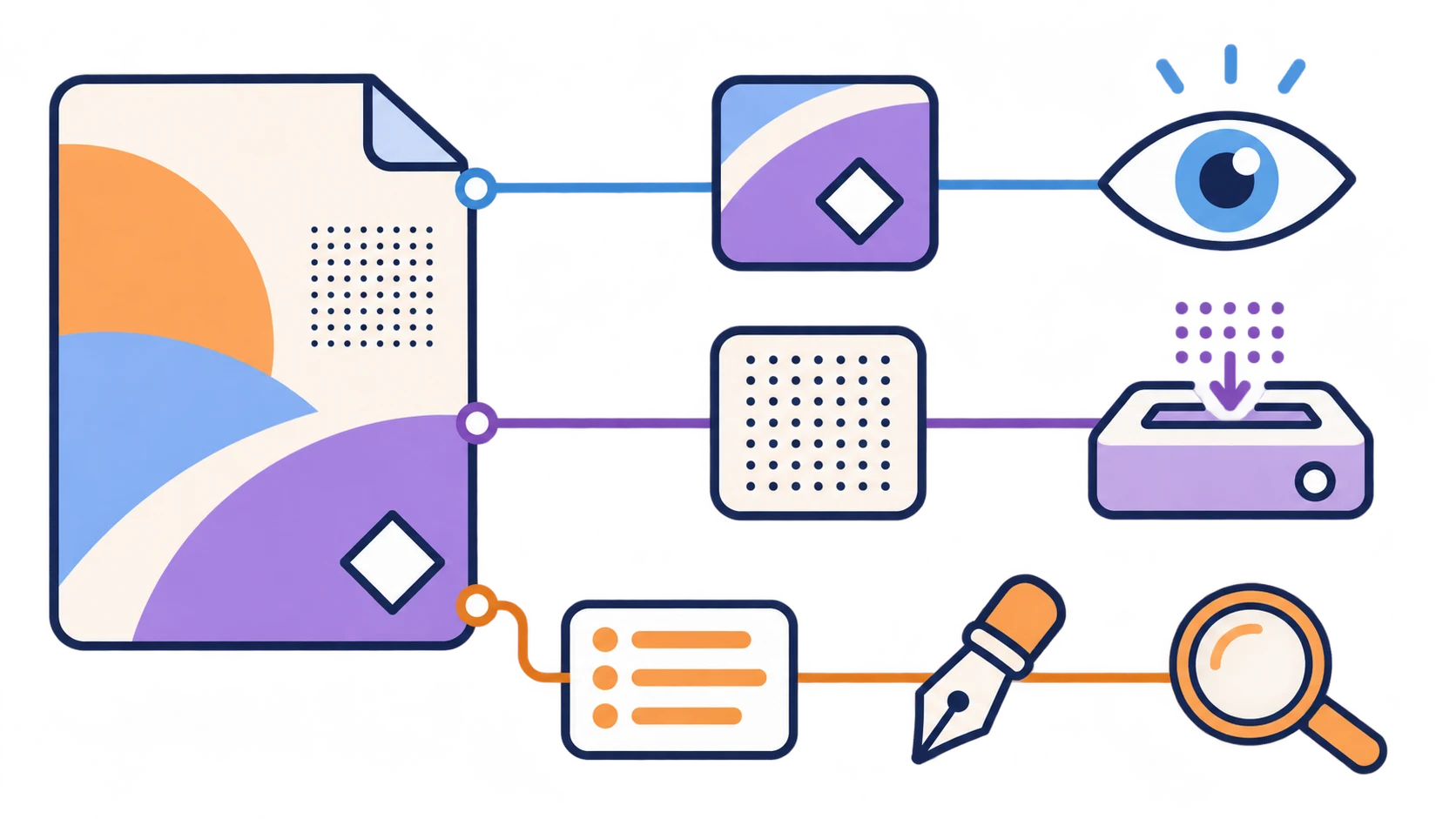
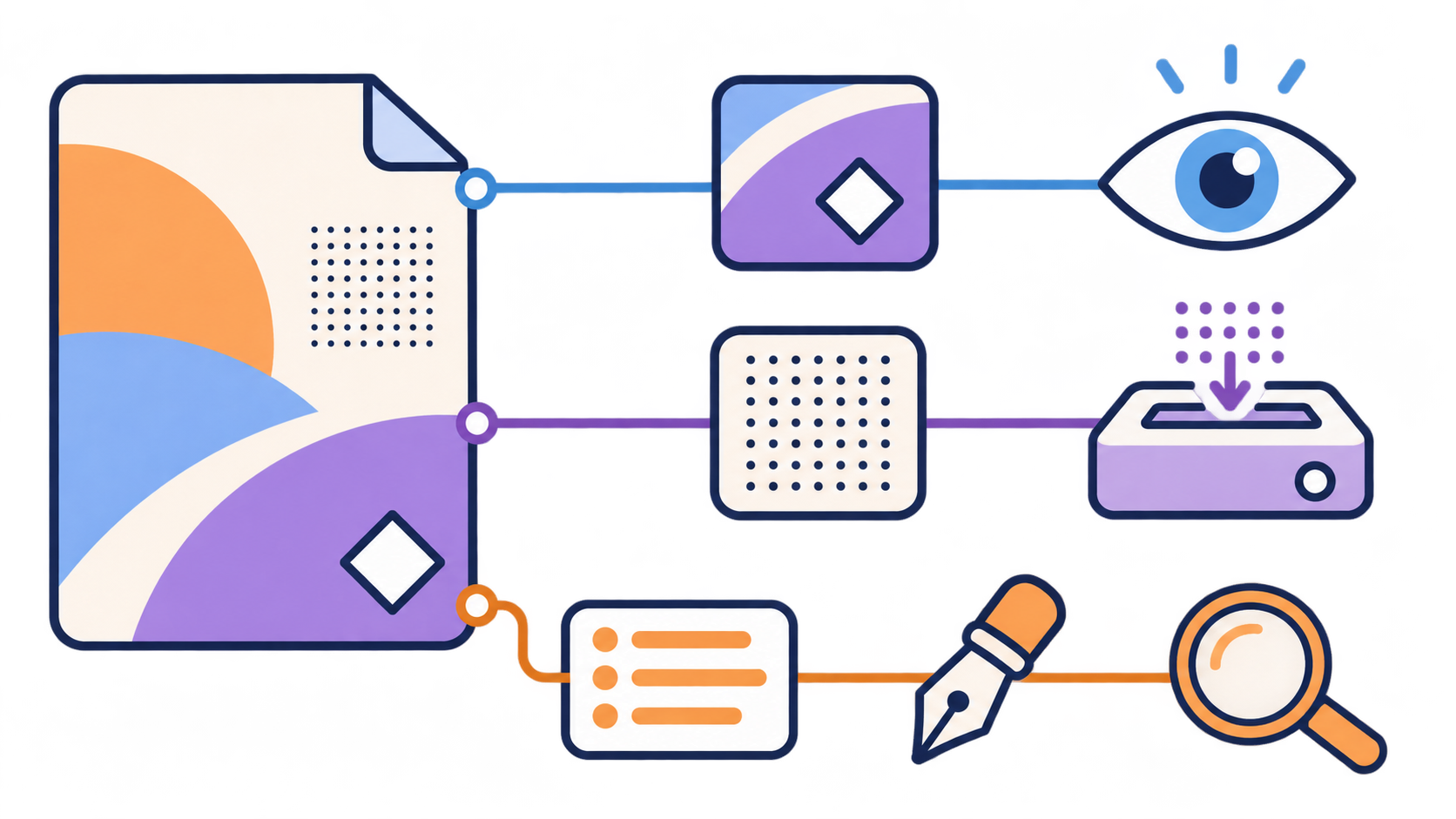
You add a watermark to an AI image, then send it to a client or publish it. What can someone actually establish from that file? The answer depends on whether you added a label for people, a signal for a particular detector, or verifiable provenance statements. These are different kinds of evidence—not interchangeable versions of “verified.”
A useful starting point for ai image watermarking is therefore the recipient’s question: do they need a visible disclosure, detection of a particular watermark, or a way to inspect the provenance supplied with the file?
Three mechanisms, three questions
Hugging Face’s AI Watermarking 101 explains visible and invisible watermarks, including the distinction between embedding during generation and adding a watermark afterward. It also discusses signing as a related technique. Published in February 2024, it supports these basic distinctions, not a guarantee of current tool availability or performance.
| Mechanism | Main question it addresses | How to check it | What it does not establish |
|---|---|---|---|
| Visible mark | What is the publisher telling the viewer? | Inspect the label or graphic in the delivered or published copy | The mark alone does not establish the generating model, complete edit history, or ownership of rights |
| Invisible watermark | Is a signal defined by a particular scheme detectable in this file? | Use a detector compatible with that scheme and retain its output and conditions | A negative result does not establish that the image is not AI-generated; a positive result does not establish copyright ownership |
| C2PA signed provenance | What provenance statements accompany the file, and can their signatures be validated? | Use a compatible verifier to inspect statements, signer information, and validation status | A valid signature does not establish that the depicted event is real or that all necessary rights are held |
A visible mark communicates directly. “AI-generated illustration,” for example, helps a viewer interpret an image, but it remains a publisher’s assertion. The label can be cropped or obscured; it is not a tamper-proof guarantee.
Invisible watermarks require the right detection method. The source explicitly describes its featured image-watermark detectors as approach-specific. An arbitrary AI-image classifier is therefore not a universal watermark reader. Nor does one detector’s negative result rule out every other watermarking scheme.
C2PA follows a signed-provenance route rather than being synonymous with a hidden pixel watermark. The two can be combined, but they need separate checks. Reading provenance text is also not the same as validating a signature. Even after successful validation, the statements and signer still need to be assessed for the intended use.
Preserve the relationship between files
For a publishing or delivery team, “watermarked” is less useful than a traceable relationship between the starting file and the copy someone receives. The following is a recommended recordkeeping method, not a tested product workflow.
Keep the file as received or directly exported from the generation tool. Do not overwrite it with a compressed derivative. If watermarking or signing happens afterward, retain that version separately. Here, “original” means the starting point of your workflow—not independently established authenticity.
For each publication use, record the actual processing route: input file, cropping or resizing, export format, dimensions, available quality settings, and any later processing by a content management system or publishing platform. If a setting is unavailable, write “automatic platform processing; parameters unknown.” Do not invent a value.
A shared asset identifier can connect the records. They should answer:
- Which watermarking or signing scheme was used, and at which version was it applied?
- Which export produced the published copy, and what processing followed?
- Which exact file was checked, with which tool or scheme version, when, and with what result?
This does not require a complex system. It requires enough detail for a colleague to find the same file and repeat the check, rather than encountering an unexplained “checked” badge.
Sample the routes that actually reach publication
Checking only an archived original does not tell you what remains in a published copy. As a practical sampling approach, select examples from the processing routes you actually use: direct delivery, a resized export, or a copy downloaded after platform processing. Do not add artificial routes just to fill out a test plan.
For visible marks, inspect readability and cropping at the final display size. For invisible watermarks, check both the retained watermarked version and selected publication copies with the scheme’s corresponding detector; keep the original tool output. For C2PA, record the provenance statements and validation status shown by the verifier, not merely an icon.
If the retained version verifies but the published copy does not, investigate the processing route. That difference alone does not identify a particular compression, crop, or upload as the cause. Compare adjacent versions to narrow down where the result changed.
Sampling has limits: checking one size and route does not verify every format, size, or platform. No compression-resistance, crop-resistance, or detection-rate tests are supplied here, so this method does not set a universal passing threshold.
Keep the conditions attached to “not detected”
A useful delivery note says: “No watermark was detected in this exported copy using the recorded scheme’s detector.” It should not become: “This image was not AI-generated.” The first reports an observation; the second exceeds it.
The same care applies when C2PA cannot be validated. Record the status the tool actually reports. Missing information, unsupported functionality, and failed validation should not be collapsed into a single “fake image” verdict. If the reason is not supplied, leave it unknown.
Watermarks, signed provenance, and retained files can complement one another. None alone guarantees copyright protection, prevents removal, or provides absolute proof of origin. A useful handoff makes each conclusion traceable to a particular file, mechanism, and set of checking conditions.
Related articles and cases
- AI Image Content Moderation: Screening, Human Review, and API Integration
Design a moderation workflow for generated ecommerce ad images, with separate input and output checks, version-linked review records, human escalation, and traceable appeals.
- C2PA and AI Images: What Content Credentials Can—and Cannot—Tell You
Content Credentials concern provenance and editing history, not a blanket verdict on truth or permission to publish. Separate those questions from AI-image detection, and keep review notes tied to the specific files you receive and edit.
- Is AI Generated Image Detection Reliable? Scores, False Positives, and Human Review
An AI image detection score is a review signal, not proof of origin. Learn what pixel classifiers measure, why false positives matter, and how to review compressed, cropped, or partly edited images.