AI Image Content Moderation: Screening, Human Review, and API Integration
Design a moderation workflow for generated ecommerce ad images, with separate input and output checks, version-linked review records, human escalation, and traceable appeals.
·
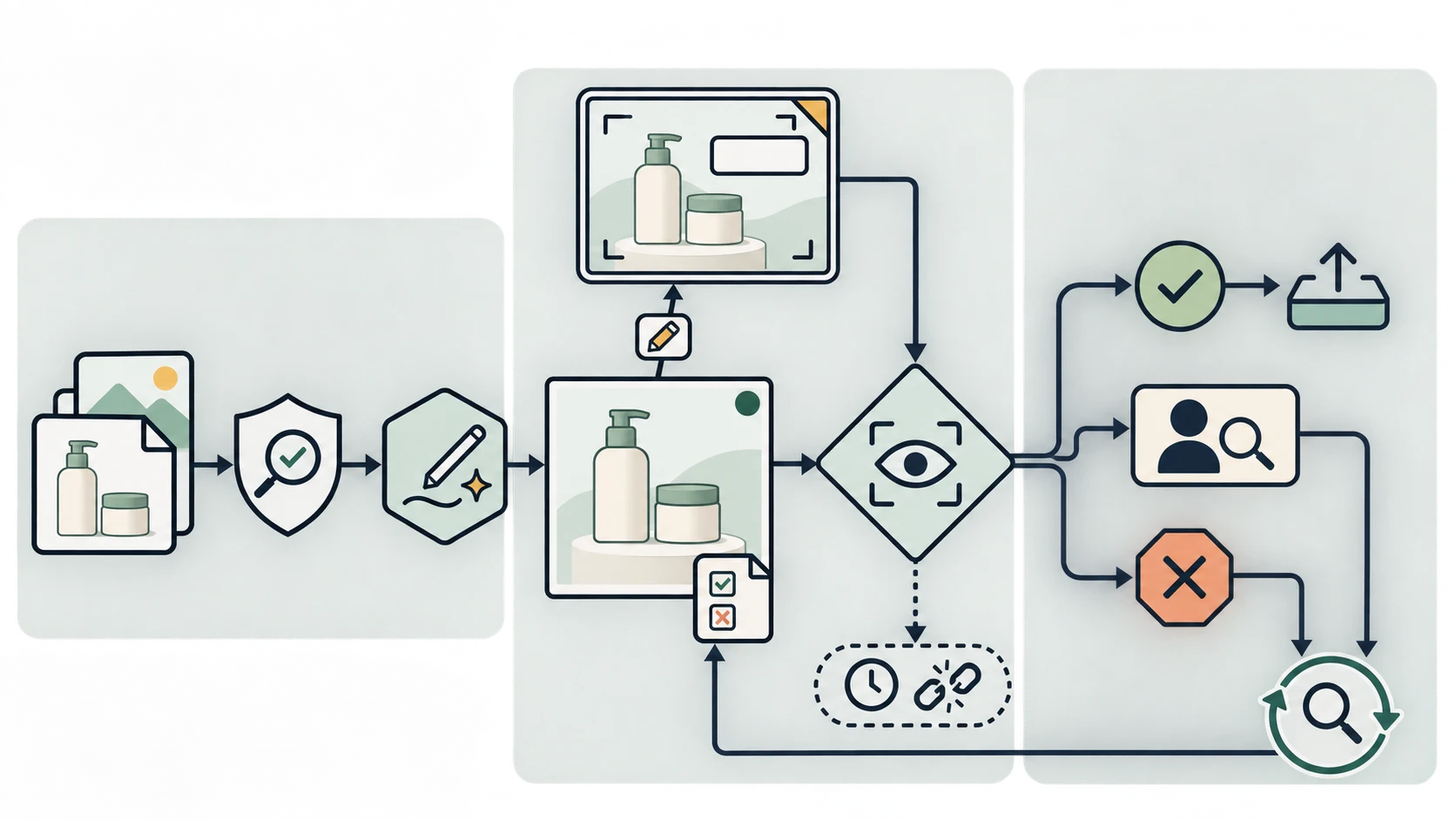
A successfully generated ecommerce ad image is not necessarily ready to publish. An acceptable prompt can still produce an image that needs review. A classifier that raises no flags cannot, by itself, verify product claims or the context in which the ad will appear.
AI image content moderation is therefore more than choosing a classification endpoint. The operational question is: which version was checked, what evidence informed the decision, and does that decision authorize publication? The following is a proposed internal design—not a vendor API specification or a claim that InkRoom provides moderation features.
Give publication permission to a version, not a generation job
Consider a hypothetical skincare ad. The team generates an image, adds promotional copy, changes the crop, and exports several sizes. Treat the original and the final creative as separate review objects. Approval of the original should not automatically approve newly added text or a changed crop.
One possible design moves a new version into a pending state, then routes it to publication approval, human review, or rejection under internal policy. Timeouts, unparseable responses, and unsupported classifications should enter a separate exception state rather than defaulting to approval.
The publishing system should check the effective decision for the current asset version, not whether generation completed. An appeal reversal should update that version's publication eligibility too; otherwise, the review queue and the delivery system can disagree.
There is a useful real-world distinction behind this design. Cloudinary's official article discusses separate controls for sharing pending assets in a media library and delivering pending assets. The supplied text is dated September 1, 2022, and was retrieved in the research pack on November 23, 2026. It supports the workflow distinction, not a claim about current configuration or API availability.
Input screening, image classification, and human decisions do different work
Before generation, input screening checks prompts and submitted materials against your product policy. It is an upstream control, not a substitute for examining pixels that do not yet exist.
After generation, automated classification supplies candidate risk signals. Before integrating a service, verify its supported categories, input requirements, score definitions, failure responses, and version information in current official documentation. For asynchronous processing, also verify callbacks, retries, and result retrieval. The supplied material does not establish these contracts, so a runnable vendor request, field mapping, or numerical threshold cannot be provided responsibly here.
A classification score is not a final compliance finding. Without a documented definition, do not describe it as the probability of a violation. A general image classification result also cannot establish that promotional wording is accurate, the product is represented faithfully, or a particular advertising platform's requirements are satisfied. Platform rules and legal requirements have not been verified in the supplied evidence and remain unknown.
Human review adds context. For the skincare example, a reviewer could check the final export against the reviewed version, flag promotional wording that needs separate substantiation, and assess a classifier flag under an approved internal policy. If the policy does not cover the situation, escalate to its owner rather than asking an individual reviewer to invent a rule.
Keep enough evidence to reconstruct a decision
These are suggested internal record fields for an ecommerce ad workflow. They are not vendor API fields or platform requirements.
| Internal record | Suggested contents | Why it matters |
|---|---|---|
| Asset and version identity | Internal asset ID, version ID, content digest or hash, parent version | Prevents approval from being applied to a different image |
| Intended use | Product, placement, target market, associated copy version | Gives reviewers the advertising context |
| Automated check | Service and version identifiers where available, original categories and scores, check time, error state | Preserves evidence beyond a pass/fail label |
| Policy and routing basis | Internal policy version, applicable rule, threshold configuration version, escalation reason | Explains why the image followed a route |
| Human decision | Reviewer or role, outcome, rationale, time, missing evidence | Separates a model signal from an accountable decision |
| Appeal and publication link | Challenged decision ID, additional evidence, reversal history, current publication eligibility | Connects changes in the decision to delivery |
These records do not need to live in one database table; they need reliable links. Traceability does not require copying every image, full input, or piece of personal information into logs. Data scope, access, and retention need a separate decision; no privacy compliance conclusion is established here.
A practical integration edge case is a late result. If the classification callback for an old version arrives after a replacement was uploaded, it should update only the old version. Duplicate callbacks should not create duplicate decisions. An automated job should not silently overwrite a later human decision or appeal reversal. A useful design separates check events from the effective decision and updates publication eligibility through explicit state-transition rules.
Evaluate routing through false positives, misses, and appeals
Choose thresholds using product policy and a labeled test set, not a supposedly universal number. Organize examples by risk category and relevant product context. Include clearly allowed, clearly disallowed, and disputed boundary cases; resolve labeling disagreements before evaluating automatic routing.
A swimwear ad incorrectly rejected could illustrate a false positive. A violent image that should have been blocked but was released could illustrate a false negative. These are hypothetical examples, not measured outcomes or statements about any platform's rules.
Define denominators explicitly. The false-positive rate is the share of actually allowed examples incorrectly classified as disallowed. The false-negative rate is the share of actually disallowed examples incorrectly classified as allowed. Human-review referrals are neither automatic approvals nor automatic rejections: report their share and eventual decisions separately. Otherwise, a system that sends everything to humans can appear to prevent every automatic miss while concealing the entire review workload.
Sample automatically approved images as well. Reviewing blocked images can reveal some false positives, but it cannot estimate misses in the approved stream. If only part of that stream is reviewed, report the sampling scope rather than presenting the discovered count as a full-population miss rate.
An appeal should point to the original version and decision, with reasons for upholding, reversing, or requesting more evidence. Feed disputed cases into policy discussion and labeling work while keeping an independent evaluation set. Do not turn every successful appeal into an immediate global threshold change.
There is still a production gate: obtain the moderation provider's current official contract, confirm the required categories and error-handling mechanisms, and validate routing against your own test set. The available evidence supports an internal workflow design—not a claim that a particular moderation API can implement it.
Related articles and cases
- C2PA and AI Images: What Content Credentials Can—and Cannot—Tell You
Content Credentials concern provenance and editing history, not a blanket verdict on truth or permission to publish. Separate those questions from AI-image detection, and keep review notes tied to the specific files you receive and edit.
- Is AI Generated Image Detection Reliable? Scores, False Positives, and Human Review
An AI image detection score is a review signal, not proof of origin. Learn what pixel classifiers measure, why false positives matter, and how to review compressed, cropped, or partly edited images.