AI Image Generation Energy Consumption: What Counts as One Image?
A useful energy comparison starts with a shared measurement boundary and a clear definition of the output. Separate training from inference, GPU readings from facility energy, and generation cost from electricity use before comparing models.
·
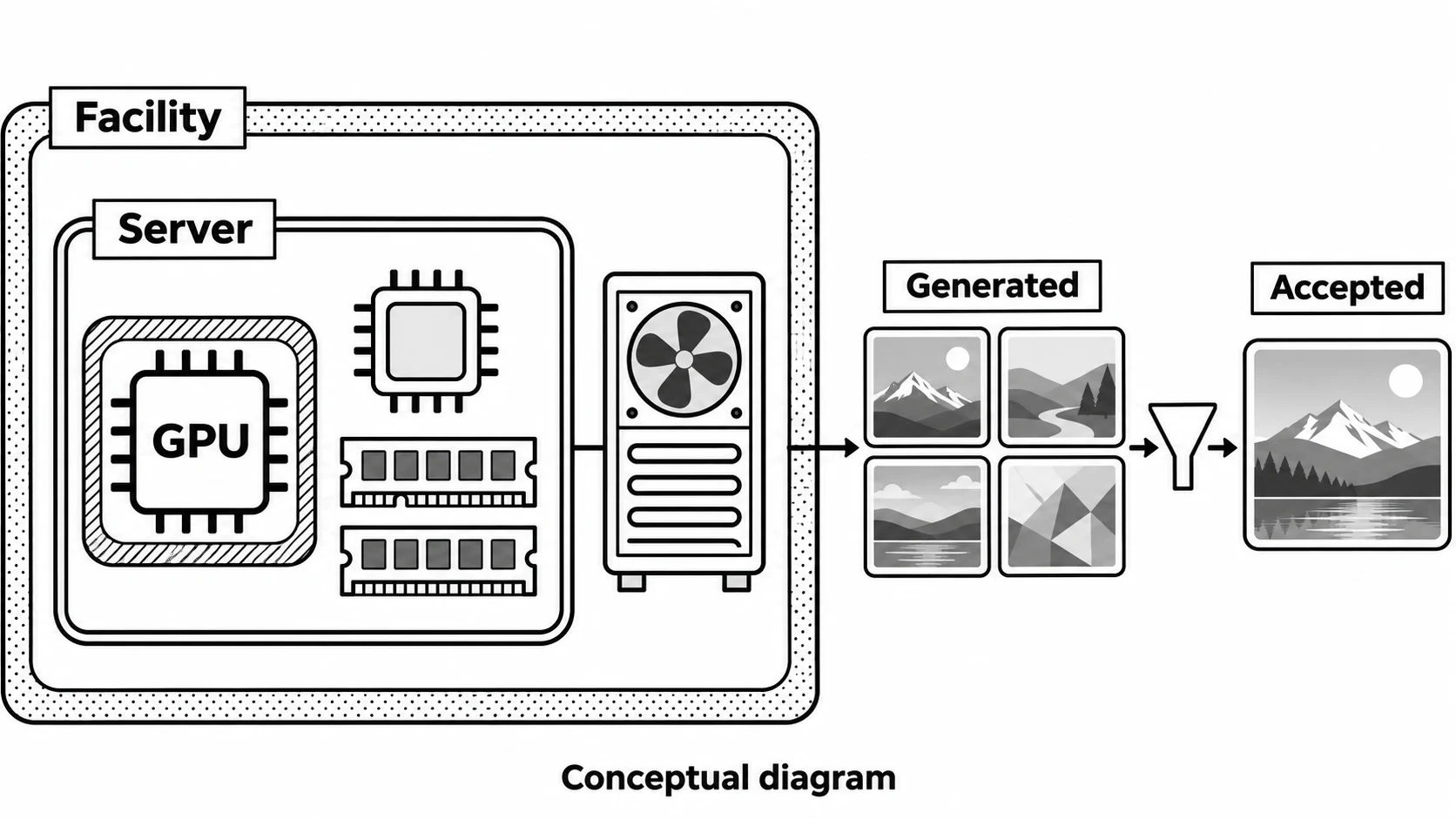
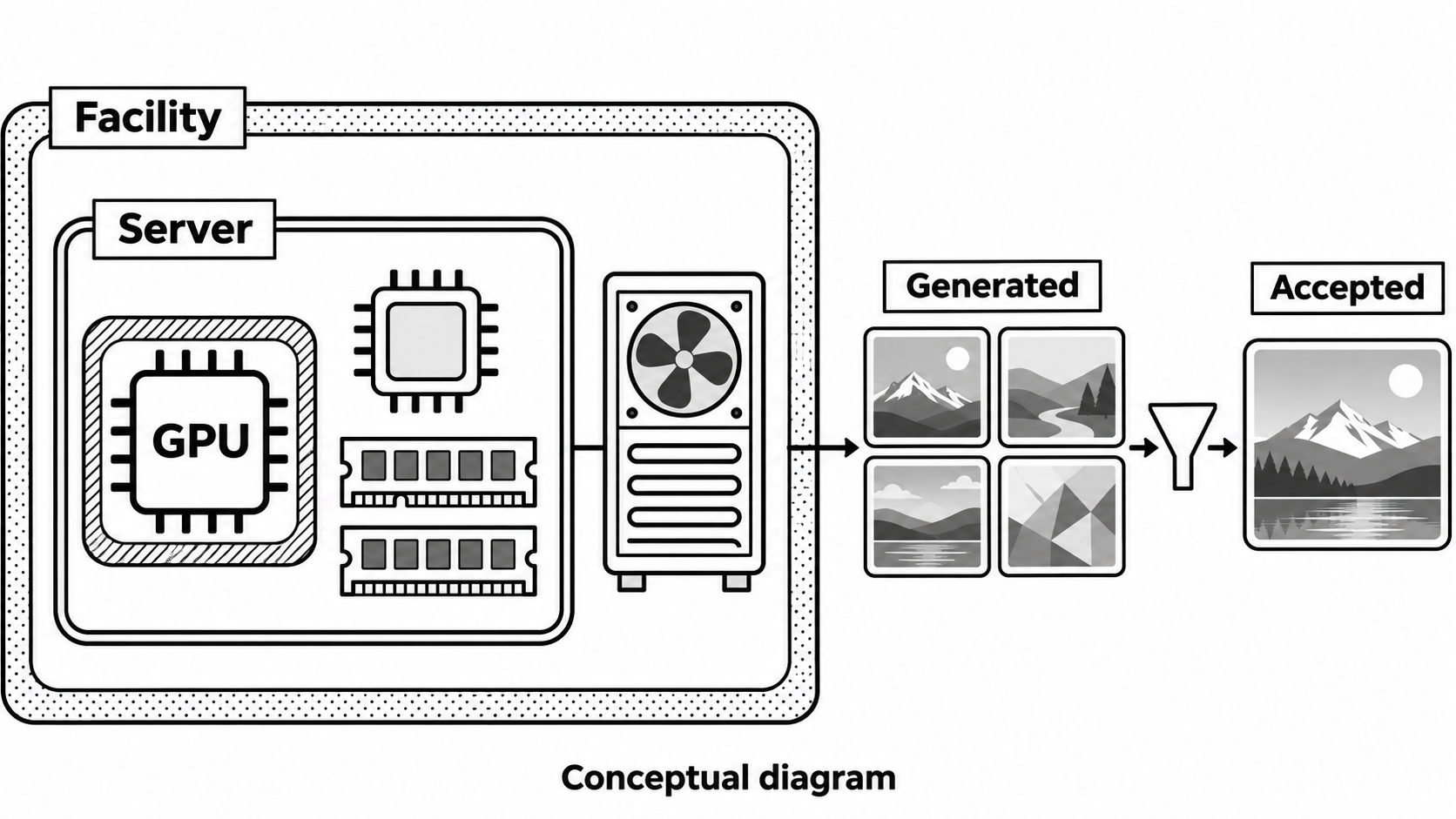
How much electricity does one AI-generated image use? Before looking for a universal number, ask what “one image” means. It might mean one request, one successfully generated output, or the usable image left after several retries. Those denominators answer different questions.
A defensible comparison of AI image generation energy consumption needs the same measurement boundary and output requirements. The supplied evidence contains no verifiable per-image model measurements, so this article does not rank models or give an industry-wide average.
The image you generate is not always the image you deliver
For an inference study, you might want electricity used to generate outputs under specified conditions. For a production decision, electricity per deliverable image can be more useful.
Consider keeping both measures:
- Energy per successfully generated image = task-attributed energy within the measurement window ÷ successfully generated images.
- Energy per deliverable image = total energy included in the delivery workflow ÷ images meeting an agreed acceptance standard.
These are proposed accounting methods, not measured findings. If the delivery workflow includes retries, upscaling, or editing, state whether their energy is included. Unmeasured stages are not automatically zero. Define acceptance criteria before testing—for example, required dimensions, an intact subject, or usable lettering—rather than changing the standard after seeing the outputs.
If no image qualifies, the second ratio is undefined. Report zero deliverables and the energy consumed instead of presenting a normal-looking per-image result.
What does the meter actually cover?
Science Friday’s interview with researcher Jesse Dodge discusses AI hardware, electricity, and environmental impacts, repeatedly emphasizing the need for transparency. It explains why disclosure matters; it is not a current benchmark of image models.
Several distinctions matter when interpreting an energy claim.
Training is not a generation request. Training creates or updates a model; inference uses an existing model to produce an output. Allocating training electricity to individual images requires a separate allocation rule and an assumed volume of use. A training total is not a measurement of one inference.
Power is not energy. Watts describe power; watt-hours or kilowatt-hours describe energy over time. A rated power limit is not a task-level energy reading. Estimating energy from power samples also requires the sampling method and measured components to be disclosed.
A GPU is not a server, and a server is not a facility. GPU telemetry, whole-machine meters, and facility measurements cover different things. Power usage effectiveness, or PUE, is the ratio of total facility energy to IT equipment energy—not an efficiency score for a graphics card. A facility estimate requires an appropriate IT-energy boundary and a supported PUE for the relevant period. Do not treat GPU-only energy as complete IT energy, or add facility overhead twice.
No official facility-specific PUE evidence was supplied, so no PUE value is applied here. Electricity use also does not establish a complete environmental footprint: emissions, water use, and hardware manufacturing require separate evidence.
A comparison record worth keeping
Use one copy of this proposed template per comparison candidate. It contains no test results. Mark unavailable information as unknown rather than substituting a typical configuration.
| Record | What to document | Why it matters |
|---|---|---|
| Model and environment | Name, version or checkpoint, software versions, numerical precision | Separates model identity from deployment differences |
| Inputs and outputs | Shared prompt set, reference inputs, dimensions, output count, seeds or sampling rule | Keeps the task and delivery requirements comparable |
| Inference settings | Steps, sampling settings, batch size, concurrency; unknown where hidden | Prevents unlike configurations being reported as a model-only comparison |
| Hardware | GPU type and count, host details, shared or dedicated use | Identifies the measured system and attribution limits |
| Timing and queue | Measurement date, start and end, treatment of warm-up, loading, and waiting | Avoids treating queue time as computation time |
| Energy measurement | GPU, machine, or facility boundary; meter or telemetry method; sampling interval; idle-energy treatment | Makes the reported energy interpretable |
| Completion and delivery | Requests, output images, failures, retries, accepted images, acceptance rules | Supports both generation-success and delivery measures |
| Repeated runs | Raw records for each run, number of runs, observed variation | Prevents a single run from being presented as stable performance |
| Facility estimate | Official PUE source and applicable period, or unknown | Separates estimation from direct measurement |
Decide what comparison you are making before running it. “How do these models differ under closely controlled settings?” is not the same question as “How much electricity do these workflows need to meet the same brief?” The latter may use different settings, but those differences must be disclosed, and the conclusion applies to the workflows tested.
For an online service without server-side measurement disclosure, browser waiting time is not a substitute for electricity data. You can still record charges, elapsed time, and acceptance rate. Energy remains unknown.
Keep the cost ledger separate
A lower price per image does not establish lower electricity use. Nor does a shorter runtime, by itself, establish lower total energy.
For batch production, keep actual spending per accepted image alongside measured energy per accepted image, using the same delivery requirement. If only spending is available, make a cost comparison—not an energy-efficiency claim. Record batching, retries, and post-processing without assuming that batching must save energy.
The useful output available now is a comparison plan, not a model leaderboard. A numerical conclusion still needs comparable measurements, traceable raw records, and measurement dates.
Source note: the Science Friday interview provides background on transparency. The supplied retrieval date is November 23, 2026; it is not a publication, update, or experiment date. A confirmed content-validity date was not supplied. No energy tests or visual inspection of source images were performed for this article.
Related articles and cases
- Seedream 5.5 announced: 100-edit demo, native RGBA and the future Pro version
ByteDance Seed’s November 9, 2026 announcement describes more stable editing, native transparency and improved text rendering. Here is what the company reports, what its evaluations do not establish, and why access and API availability remain unverified in the supplied material.
- AI Image Generation API Comparison: Versions, Billing, and Reproducible Evaluation
A request, an output, and an accepted deliverable are different units. Use a traceable configuration and billing record to compare image APIs without confusing advertised prices with delivery costs.
- Canva Craft AI Image Model: Reported Launch, Capabilities and API Status
Third-party reporting dates Canva Craft’s launch to October 22, 2026, and describes composition planning, up to 2K output, Dream Lab access and a preview API. Here is what that report says—and which access conditions still need official verification.
- adobe firefly max 2026: Image-feature availability remains unverified
The supplied evidence does not establish the announcement date, image-editing feature availability, beta access or third-party model selection. This is a publication hold notice, not a verified update report.